Is Binge-Watching TV Really a Pastime?
· The Atlantic
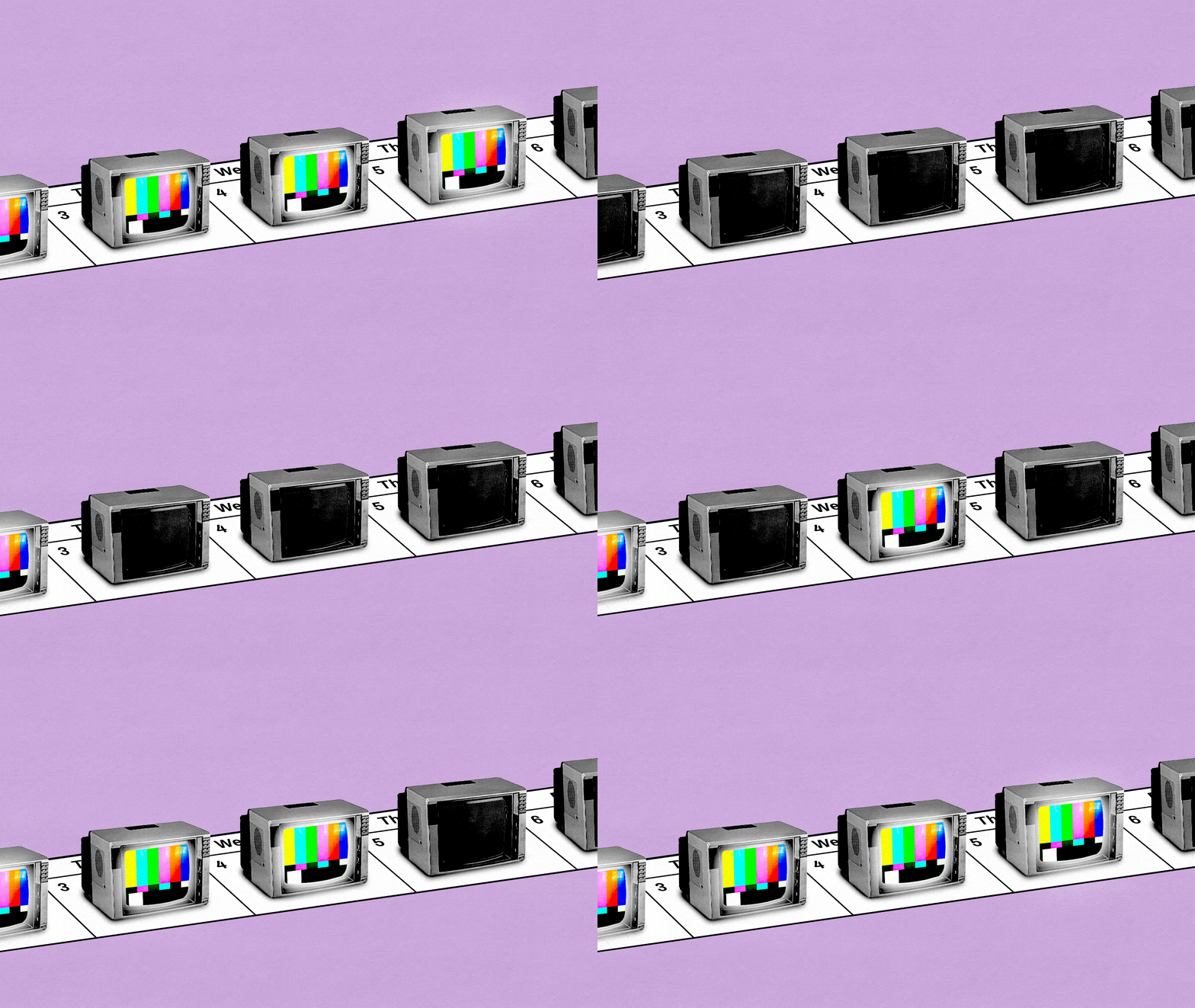
With apologies to baseball, I believe that binge-watching television may have become America’s true pastime. TV sets have ruled living rooms for decades, but gone are the days of viewers exclusively following broadcast schedules. Netflix and its peers have rendered entertainment addictively customizable and hyper-accessible, making entire seasons of shows available at once and commissioning original series of their own. Viewers with a handful of subscriptions can enjoy a staggering array of options to indulge in whenever they want: series old and new, high-brow and low-brow, scripted and unscripted. There’s seemingly no limit to the number of shows you can watch, for hours on end.
Yet an end might be nice. The very term binge-watch implies that the act is a vice, and the bulk of the (still-emerging) research about television habits has found that nonstop watching tends to yield negative psychological outcomes; these can include sleep deprivation, a sense of losing control, and melancholy upon finishing a particularly lengthy series. In 2015, a University of Toledo study found that people who spent two to five unbroken hours consuming television exhibited greater anxiety, depression, and stress levels compared with those who didn’t.
Visit extonnews.click for more information.
I can certainly attest to these effects, even as a person whose job involves keeping up with a lot of television. With the amount of programming available before me, the mere act of watching TV recently began to feel impossible. Just looking at my queue was exhausting, and I imagine that I’m not alone in feeling this way—as in, burned-out from the decision fatigue caused by scrolling through ever-expanding libraries, and from spending too many hours trying to make headway on what I’d fallen behind on, only to forget plot points the next day. Guilt crept in whenever I fell down low-stakes YouTube rabbit holes instead of using that time to catch up on a show; panic rose when I realized that my habits were likely encouraging the reported practice of rewriting scripts to accommodate people’s shortened attention spans.
[Read: The year of ambitious TV watching]
At the risk of cueing the world’s tiniest violin, I felt like my social life was taking a hit too. I couldn’t keep up with TV talk: I kept promising to start series that my friends recommended, even though I still needed to finish, let’s see, Industry and The Traitors and A Knight of the Seven Kingdoms and The Diplomat and Love Story and Wonder Man and Bridgerton and—hang on. How is it possible that the new season of The Pitt is already almost over?
Eventually, I hit pause altogether on watching TV in my free time. (A dire call, considering my job involves keeping up with shows.) Maybe, I thought, I could approach my bloated queue differently. Instead of sporadically choosing a title and plowing through several episodes to determine whether I even enjoyed it, could I somehow make watching TV feel less taxing and more mentally invigorating? Possibly, according to a study published in Acta Psychologica last year. The researchers found that stories that linger in people’s memories can make individuals feel more fulfilled because they’re using what they watched to contextualize the world around them. That tends to happen when the person has a goal in mind for engaging with TV in the first place: perhaps to disengage after a long day, feel reenergized amid a dull one, or spend comforting time with familiar characters.
Unfortunately, those positive outcomes also tend to happen after spending hours continuously immersed in a series—a finding that clashed with the goal that I had settled on: to keep up with television without feeling like I was scaling a monumental pile of homework. Faced with this conundrum, I decided to experiment with the study’s parameters. To make my climb up Mount Watch List as easy as possible, I chose to attempt the two shortest shows in my queue: Netflix’s four-hour limited series Adolescence and the Apple TV drama Pluribus, which comprises nine episodes in its first season. The entirety of Adolescence dropped at the same time upon release, and Pluribus aired weekly, but I set my own schedule, opting to view one episode of Adolescence and two of Pluribus each week over the course of a month. Perhaps the operation—neither bingeing nor avoiding TV, and instead watching at a steady pace—would fix my neuro-technical difficulties.
The “Next Episode” button immediately posed a problem for my success. Despite my aversion to speeding through several episodes at once, suddenly it was all I wanted to do. Adolescence’s sprawling ensemble cast, intense dissection of a murderer’s mind, and ambitious visual style made me wish I could watch the rest in a single sitting. As for Pluribus, its glacial pace actually made it hard for me to stop watching as well. Halting my viewing every two chapters left me impatient—and prone to encountering spoilers if I poked around online for more context.
[Read: When did TV watching peak?]
The more I slowed down, however, the more attention I paid to the storytelling. Knowing that I wouldn’t get more Pluribus for the day made me want more out of the show: I replayed scenes I liked, scrutinized Rhea Seehorn’s performance as the reluctant heroine, and paused on a shot of a character’s notebook to scan for clues. I didn’t seek to linger in the world of Adolescence in the same way; it’s too bleak for a rewatch of any length. But I found that I absorbed everything much more carefully, just so I could retain the facts during my wait for the next installment.
As the weeks went on, it occurred to me that my TV-watching stress hadn’t been about the quantity or quality of the shows I took in, but about how I thought of them. Before this thoroughly unscientific endeavor, I had felt like I was always playing catch-up. Making my way through Adolescence and Pluribus didn’t evoke that sensation, perhaps because I didn’t feel pressured to finish them quickly. I’d made watching TV an active undertaking, rather than an exhausting interruption in my routine. In the moments after I finished both shows, I felt strangely accomplished—and a little surprised at how much I looked forward to beginning another.
That said, in the weeks since, I haven’t miraculously become capable of fatigue-free viewing. My minimal efforts—following the classic method of setting a schedule and giving real thought into what to put on—haven’t turned everything around, and I’m not surprised. Maybe the right show will do the trick, but to get there, I’ll need to push the experiment further by testing different genres, run times, and streaming platforms. It’s helpful, then, that I’ve managed to return to TV in my idle hours; I’m thrilled for the winning snake-charmer traitor on The Traitors, and I’m looking forward to the rest of The Pitt. In other words, I’m just enjoying television the way the medium was meant to be enjoyed: in moderation.